
The Unfinished Journey

In his 1926 masterpiece of disillusionment, ‘The Sun Also Rises,’ Ernest Hemingway gave the twentieth century one of its most enduring expressions: ‘The Lost Generation’. In the novel, Hemingway was speaking of young men and women who survived the Great War but were shattered by it, wandering through Europe searching for something they could no longer name. The war for them was a cataclysm that had effectively unmoored them from the traditional moral and social maps of their ancestors.
For these young people, the postwar world felt like a landscape stripped of meaning. They were adrift not merely geographically, but existentially. They were searching for a substitute for the faith they had lost, but the search itself felt futile, leaving them in a state of perpetual, restless wandering. It’s a difficult, unsettling read.
Every year, as we close the Book of Numbers, I find myself thinking of another lost generation. Not a generation that lost its faith. The generation that lost its destination.
This Shabbat, our weekly Torah readings in the Book of Bamidbar (Numbers) come to a close with the reading of its final two portions, Matot and Masei. Each year at this moment, when I reach the final verses of the Book of Numbers, I find myself lingering. History has moved on. And somehow, so must we. Yet I cannot help but look back.
There is something haunting about the closing of this book; something that fills me with an emotion I struggle to name. It is not sorrow, it is something subtler—a sense of standing at the edge of a long, unfulfilled journey, watching familiar figures that are somehow a part of me disappear into the mists of history.
Much of this book had focused on the enigmatic ‘Generation of the Wilderness.’ These are the Israelites who participated in the Exodus from Egypt; they started out with great spiritual potential. But ‘Better is the end of a thing than its beginning’, King Solomon teaches in Ecc. 7:8. Although they got off to a good start, this unique group of souls are generally remembered for their failures. Indeed, we have been taught to read their life story as a cautionary tale. They are usually referred to as the generation that failed to enter the Land, as if that disappointment defines their essence. Perhaps it does. ‘All’s well that ends well,’ Shakespeare wrote, and it did not end well for these people. But yet our sages also remember their inimitable greatness: They were the only generation to hear G-d speak from fire. They ate manna that descended from heaven, the bread of angels. They lived beneath Clouds of Glory. They carried the tabernacle throughout 42 journeys in the wilderness. They experienced an intimate connection to God that no generation before or since has ever known. Tradition relates that there will never be another generation as holy as they were.
And yet...they were human. Flawed and weak. These very individuals who participated in the miraculous Exodus from Egypt and stood trembling at Mount Sinai, witnessing the transcendental experience of the revelation, were plagued by doubts and lapses of faith throughout their lives. They gathered manna each day with the morning dew, yet they were fearful that God abandoned them; they were obstinate and complaining. Ultimately, they were condemned to die outside the land on account of the debacle of the spies, and it was to be their children who would enter into the Promised Land. That great and inscrutable generation, buried without names somewhere in the wilderness, seem to fade into oblivion. Without fanfare, they are simply…gone. No grand farewells, no eulogies were given; no monuments erected. Torah allowed us to accompany these extraordinary, infuriating, luminous people for an entire book. We watched them complain. We watched them sing. We watched them fall, and we watched them rise, over and over again. And suddenly...they are gone. History moves on. It always does.
Torah never adorned them, and never attempted to excuse or whitewash their shortcomings. Yet despite their occasional insufferably negative behavior, they also had moments of true greatness, wherein they rose to magnificent spiritual heights. Which is to say—they were just like us.
There is something profoundly comforting – sobering too – in that realization. Sometimes we imagine that if only we had lived in Biblical times...if only we had witnessed miracles...If only God would reveal Himself...that certainty would uproot all doubt, and faith would be effortless.
But the Book of Numbers dismantles that illusion. No generation ever received greater revelation, possessed greater ‘proof of God.’ And no generation ever wrestled more deeply with uncertainty.
The human heart, it seems, remains capable of doubt even while surrounded by miracles. Faith has never depended upon seeing. It has always depended upon choosing.
Why did God leave them there for forty years? To call it a ‘punishment’ is a woefully myopic understanding that falls short and rings hollow. Punishment was not the issue (and anyway, God doesn’t punish us…we punish ourselves, through our own negative choices). The fact is, they were simply not ready to enter the land, and it finally became clear that they never would be. But Torah is for all generations, and it wasn’t only about them…they transcended themselves and became a metaphor for all time. The wilderness becomes the landscape for every human life; an allusion to every stage of life where we cannot yet see the destination.
At first glance, the desert appears empty—a place of deprivation, and endless wandering. Yet over time it reveals itself as something else entirely.
How much of our lives are spent walking through deserts of one kind or another? Waiting for answers. Traveling. Packing and unpacking our hopes. Following roads whose destinations we cannot yet discern; following the patterns of clouds we don’t understand. Believing we have lost our way, only to discover much later that every detour was itself part of the journey. Isn’t that a part of every human’s biography?
I think that very little of life is actually spent arriving. Most of life is spent becoming.
Torah’s quiet transition between the Generation of the Desert and the Generation that enters into the Land conveys a powerful idea: The earlier generation disappears, but their journey does not.
Open up your heart in the deepest way: The next generation walks into the Land carrying someone else’s memories. The children inherit stories they never lived. They remember Sinai without remembering having stood there. They remember Egypt without having been slaves. They remember Miriam’s well. Aaron’s peace. Moshe’s voice.
How? Because memory can be inherited. Torah commands us over and over again to remember that we were slaves in Egypt. Moshe commands the generation about to enter the land to remember that they stood at Sinai…but they didn’t, their parents did! This is one of the greatest miracles of the Jewish people’s survival. Not only are genetics inherited—but memory is as well. Every Jew lives with his predecessor’s memories. They become his own. Each generation receives the unfinished dreams of those who came before. Each generation is entrusted with carrying them one step further. Every generation eventually becomes someone else’s memory. One day, we too will become the “Generation of...” The question is not whether we will finish the journey, but what memories we will leave to those who continue walking after us.
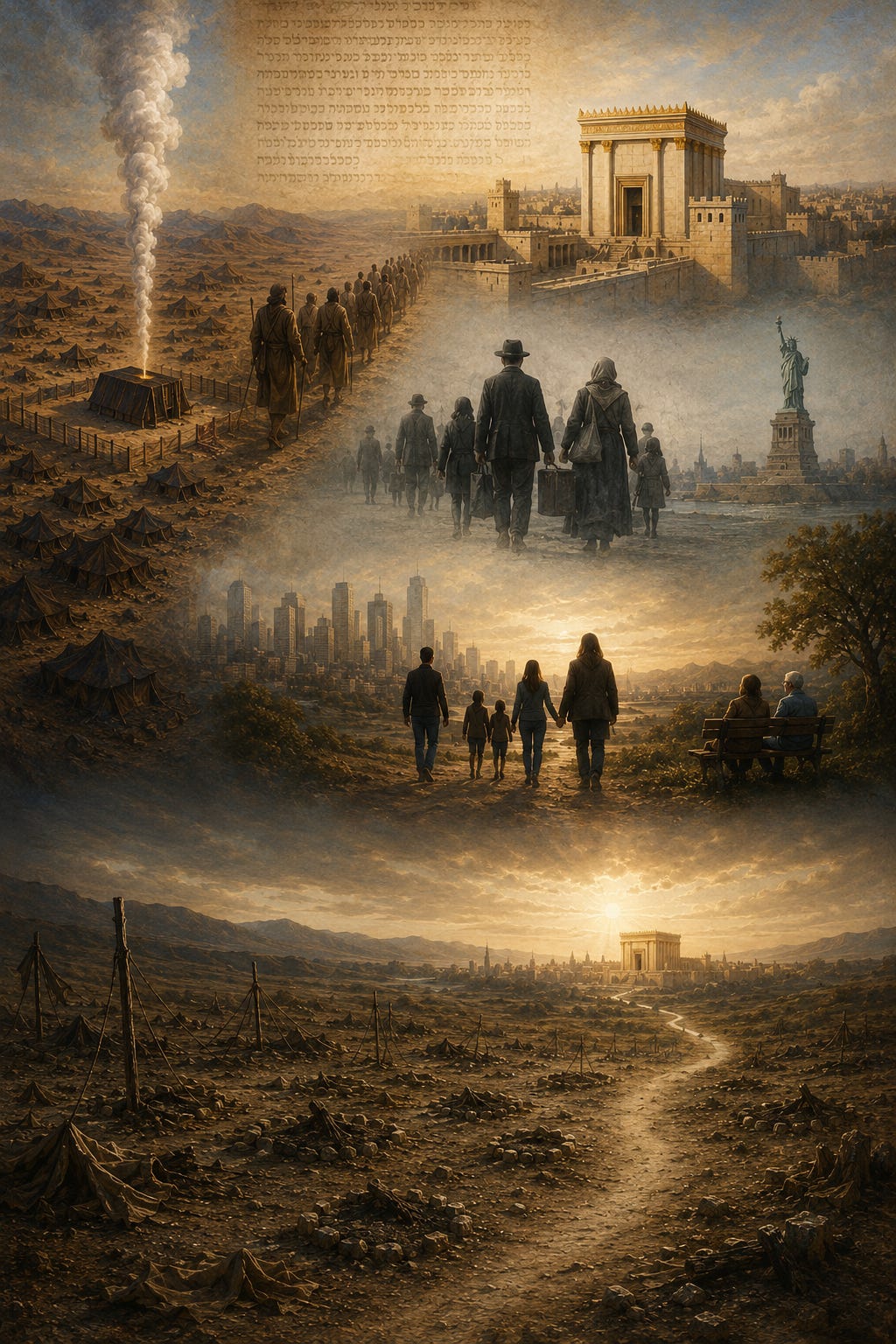
As these thoughts accompany me, I cannot help reflect upon this period of ‘The Three Weeks’, the annual period of heightened Holy Temple consciousness and introspection (most people call it ‘mourning’) beginning on the Fast Day of Tammuz 17, and culminating in Tisha B’Av. These days are also lived in the confines of a wilderness. Not geographically— but emotionally. These are days suspended between memory and hope; between broken walls and future redemption; between grief and rebuilding. Like our ancestors in the wilderness, we inhabit an unfinished landscape. We stand between what once was and what has not yet become. This describes something of the human condition that reverberates deeply: we live our lives in the sacred tension between promise and fulfillment.
The Torah ends the wilderness narrative in precisely such a place.
It ends on a threshold. The new generation stands before the Jordan. The promise lies just beyond reach. The story pauses there. Maybe it is because life itself is lived upon thresholds. Rarely do we feel that we have truly arrived. We are almost always crossing toward a horizon we cannot fully see; so often carrying both gratitude and disappointment in the same heart.
And there is another quiet truth hidden within these closing chapters of the Book of Numbers. Although the Generation of the Desert never entered the Land, nothing that followed would have been possible without them. Before we judge them for their failure, consider this: We are often tempted to measure our lives by whether we reached every destination we envisioned for ourselves. The Torah suggests another standard of measure. The greatest generation in Jewish history never reached its destination! Yet without them...there would have been no Promised Land. What a great irony, and what a profound lesson, hidden here in the Torah in plain sight: The generation that experienced the greatest closeness to G-d became the generation that never arrived. History usually celebrates those who complete the task; Torah immortalizes the travelers.
Perhaps those who prepare roads they themselves may never travel… cannot be considered to have failed?
Could it be that some lives exist not to arrive—but to prepare the road for others?
Can’t this be said about every human life on some level? Every parent who strives to build a future for their children knows this. Teachers who plant truths in young minds, whose harvest they will never witness. Dreamers who begin songs that others will one day complete. Those are not failures. It’s taking one’s place in an eternal covenant; it’s being part of something much greater than ourselves.
Maybe this is why I take leave of the Book of Numbers each year not with disappointment, but with longing. The generation of the wilderness did not complete its journey, and neither have we. Our own generation also lives between worlds—between darkness and dawn, between exile and redemption, between what humanity has become and what, with G-d’s help, it may yet become.
So back to ‘The Lost Generation.’ Hemingway’s characters felt lost because they had lost their faith in the story of civilization. Today, many feel lost because we lack a story that binds our scattered, hyper-connected lives into something coherent. We possess the GPS of high technology, yet we lack the compass of a shared purpose.
If Hemingway’s generation was lost in the wreckage of what they perceived as a collapsed world, perhaps our generation feels lost because we feel the same existential homelessness, the same anxiety about where the road is leading, and the same suspicion that the old markers have been erased. We are a generation living in the gaps between what we have, what we know, and what we actually need to feel whole.
But although we are accustomed to think of two ideas as being opposites—lost or guided—Torah is teaching us that you can be both; You can feel completely disoriented...while every step is being directed by Heaven. This is the paradox of Torah’s ‘wilderness.’ The Generation of the Desert was simultaneously the most lost and the most guided generation that ever lived. No generation ever wandered more. No generation was ever more carefully led. Every encampment was chosen by God. Every departure followed the cloud. Every stop had purpose, even when the people could not perceive it. Isn’t that one of the deepest lessons of Bamidbar? To wander is not necessarily to be abandoned.
The Book of Numbers teaches us that a wilderness is not a place where God has forgotten you. It is the place that He is leading you through. Where God wanted you to be. What looked like aimless wandering from below, is purposeful leading from above.
For me, the greatest lesson of that generation is that the deepest moments of faith are not experienced when we have arrived, but when we are still standing on the edge, carrying all our wounds, all our failures, all our hopes, and choosing to believe that beyond the horizon there is still a land we have not yet seen. There is something profoundly human about that image. It belongs not only to Israel in the plains of Moab, but to every soul that has ever looked toward tomorrow with trembling hands, keenly aware that some of the holiest moments in life are those in which we have not yet crossed.
“We possess the GPS of high technology, yet we lack the compass of a shared purpose.” Indeed!
Beautiful and a word much needed. Thank you. 🙏🏻