
What We Are Mourning For
A Tisha B'Av Reality Check

Years ago, I heard a story.
A man lost his wife, the love of his life, soon after their first child, a son, was born.
In his grief, he raised the boy alone. In his eyes and in his heart, his son was his wife’s continuation, her legacy, a testimony that proved his undying love.
Into that boy the man poured all his hopes. But the boy was also a receptacle, a living reminder of his perpetual grief; he could not move pass the death of his wife and so all revolved around the son as a living monument to his mother.
But it was a disproportionate burden for such a young boy to carry. He knew he could never live up to his father’s expectations, but tried to understand his father’s plight. He did not want to disappoint. His childhood was a walk along a tightrope, between his own emotions, and the responsibility he felt to protect his father from his grief.
Finally, the boy turned thirteen and it was time for his bar mitzvah. The father arranged for a beautiful celebration, sparing no expense. He told his son to invite all his friends, and allowed him to decide on every aspect of the party himself.
The father had only one request, upon which he insisted.
He told his son: ‘At the bar mitzvah, after you give your speech, I want you to say Kaddish for your mother. I want this to be the most emotional, powerful, heart-rending Kaddish that anyone ever said…this is the time for you to show your deep connection to her. Pour your whole spirit, your whole life into this Kaddish.’
The moment came. The boy said Kaddish…like any thirteen-year-old kid. No tears. Quickly, by rote, and ostensibly devoid of feeling. Not highly charged with emotion; nothing rousing or stirring. A 30-second prayer associated with death that can be difficult for anyone to get through, let alone a child.
The father was crestfallen. So disappointed. He said, ‘how could you do this to me? How could you do this to your mother’s memory!? I told you how important this was to me!’
The child gave way to his exasperation and told his father:
‘Abba, what do you want from me? How can you expect this of me? I don’t even know her. I have no memory of her.
I didn’t know her at all.’
This year on Tisha B’Av, falling on Thursday July 23, we will be marking 1956 years since the destruction of the Holy Temple, and the exile of the Shechina – the Divine Presence. The ‘mother’ of whom, frankly, we have no memory.
What was it like to live with the Divine Presence in our midst? That was long ago and far away. We have no memory of what the world was like with the Holy Temple. And though the descriptions of that reality taught by the Sages of Israel are resplendent in their spiritual magnificence, without having experienced it, it’s all surreal to us. We’ve never experienced anything but the world we know. How can we really be expected to understand what’s missing?
Like the child in the story, we cry because we know it’s expected of us, and we try not disappoint. But what is the meaning of our tears?
How will we spend the day of Tisha B’Av?
It’s a difficult day to fast: long, beginning the night before, and generally in the hottest time of year.
Some will manifest the customs of mourning scrupulously, according to Jewish law and practice, reciting the lamentations and the ancient kinot dirges. They will turn sincerely to God and ask Him to rebuild the Holy Temple. Others, respecting the edict that one is obliged not to divert the mind’s focus from mourning today, will study certain ‘depressing’ sections of Torah, such as the prophecies of destruction, or read books of Holocaust literature, or search YouTube for ‘Tisha B’Av appropriate’ educational videos.
In Jerusalem, thousands upon thousands of Jews will visit the Western Wall. Some of these will be of a more confrontational attitude, and exhibit some holy chutzpah, insisting in their prayers, possibly even demanding….that God rebuild the Holy Temple.
Still others will ascend the Temple Mount, in strict accordance with Torah law, not treading on the holiest areas but walking around them, desiring to be as close as possible to the holiest place on earth, the place where our forefathers prayed. Some of these will express that they are admittedly tired of this endless cycle of mourning. Some of them, including this writer, will forgo reciting some of the same prayers of mourning that we’ve reciting for almost 2,000 years. They think it’s somehow inappropriate, even a slight to God, to pretend that nothing’s happened in 2000 years, and to ask God to rebuild. We already did that, and He answered. Jerusalem has been returned to Jewish sovereignty. The responsibility is not His. Every halachic question pertaining to the rebuilding has been solved. Nothing is impeding the rebuilding of the Temple other than the resolute decision of Israel. To pretend otherwise is disingenuous. These Jews will not ask, or insist, or demand that God rebuild the Holy Temple. They will say ‘hi’neini,’ here we are, ready to rebuild.
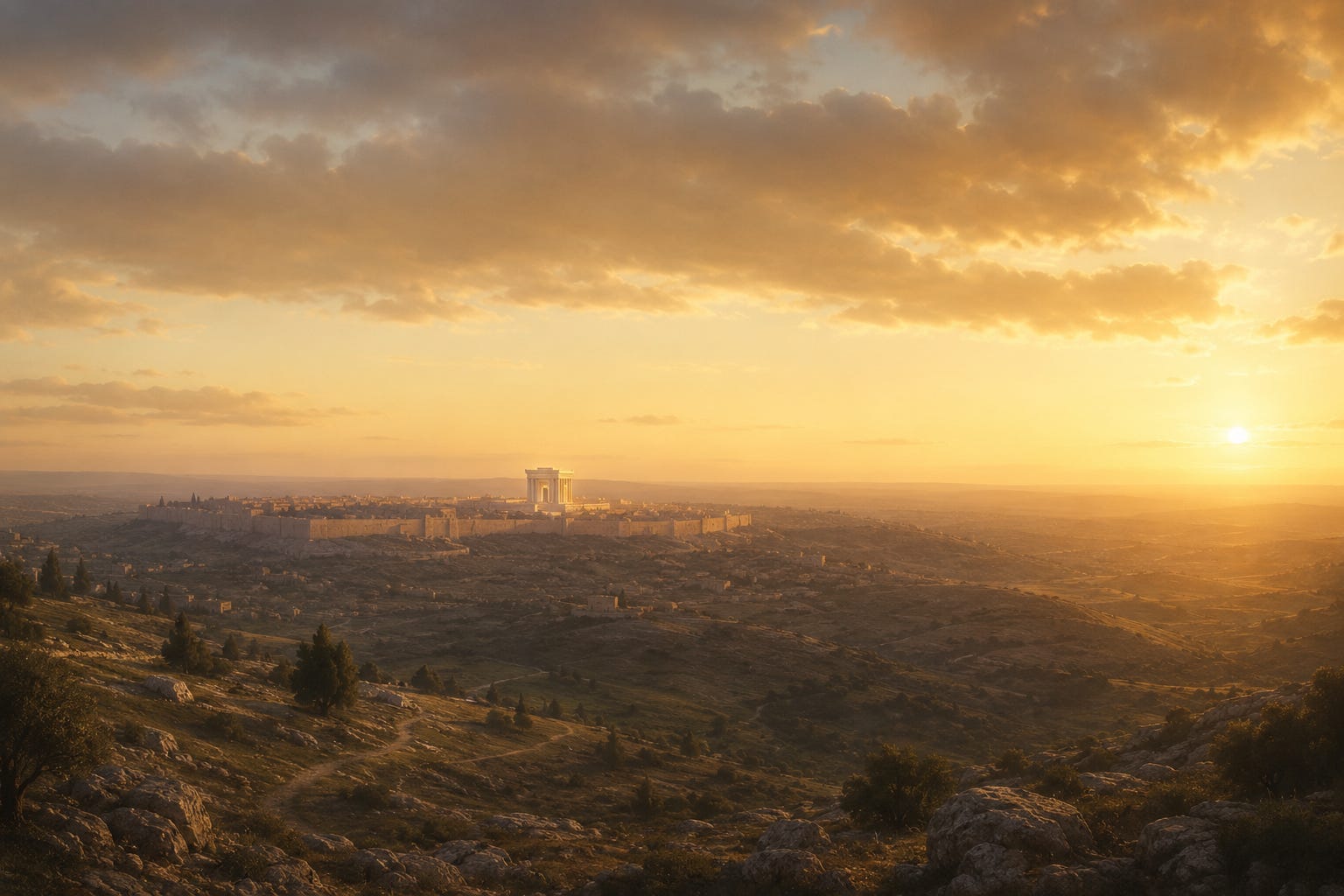
A proper study of the authentic sources of Torah wisdom reveals that building the Temple is clearly not dependent on a miracle, but on the unity and decisive action of the people of Israel. The nation has an irrevocable covenant and Divinely-mandated responsibility, on behalf of all humanity, to build the Temple and let the light into this world.
But that is an awkwardly inconvenient realization. It is easier to convince ourselves that insurmountable obstacles remain, and shift the blame onto the Almighty, as we’ve always done. Thus Haggai the prophet, exhorting the Babylonian returnees over their sluggish pace of rebuilding and lack of enthusiasm, declared way back then in a chillingly familiar note, ‘This nation has said, the time has not yet come! But I say, it is time for the Temple of Hashem to be rebuilt…is this a time for you yourselves to sit in your paneled houses, while this house is in ruins?’ (Haggai Ch. 1).
But none of this was ever simply about a building. When the Temple stood, it was the beating heart of the world. The prophet Haggai's message is that when the House of Hashem stands in its proper place, blessing flows from it because the resting of the Divine Presence brings about a state of perfection for humanity. Without the Temple, the entire world is off balance. It is the place from which Torah radiates, as foretold by Isaiah, and the place toward which the prayers of every heart ascend. Israel is challenged to fulfill its calling there—not as privilege, but as responsibility—to serve as a conduit of holiness to flow into the fabric of daily life.
This Temple was not a tribal shrine, or a nationalist monument, and thus, the prophetic vision of the Third Temple is not a nationalist climax. It’s a civilizational healing; a global shift. The blessings afforded by the Holy Temple were never about Israel alone. At the dedication of the First Temple, King Solomon asked God that also the prayer of the foreigner who comes from a distant land should be heard when directed to this House. In chapter 8 of Kings I we read: ‘Also a Gentile who is not of your people Israel, but will come from a distant land for Your name’s sake…for they will hear of Your great Name and Your strong hand and Your outstretched arm – and will come and pray towards this Temple, may You hear from Heaven, the foundation of Your abode, and act according to all that the Gentile calls out to You, so that all the peoples of the world may know Your name, to fear You as does Your people Israel, and to know that Your name is proclaimed upon this Temple that I have built.’
In Midrash Bamidbar Rabbah, the sages teach: ‘If the nations of the world had known what the Holy Temple meant for them, they would not have allowed it to be destroyed — they would have surrounded it with fortresses to protect it.’
Isaiah the prophet foresaw (2:2–3: ) “All nations shall flow to it… and many peoples shall say: Come, let us go up to the mountain of Hashem…” This is not a description of conquest, but of gravitational pull… towards healing. This future Temple, in prophetic vision, is not accomplished through war; it is the result of moral radiance. And Zechariah 8:23 says: “Ten men from the nations will grasp the corner of a Jew’s garment, saying: Let us go with you, for we have heard that God is with you.” In other words, the prophets are unequivocal that the Temple emerges from Israel successfully embodying its calling. When Israel truly lives as a kingdom of priests — when justice, humility, and compassion radiate outward — then the nations themselves will say: ‘Let us go with you. Because we have heard that God is with you.’ The Temple then becomes the gravitational center of moral reality.
Thus, from this mountain, global peace is to be established by God, envisioned and promised by the prophets of Israel, not as a result of conflict, but of convergence, because the spiritual function of the Temple is to gather the scattered sparks of the world -- and returns them to their Source. When the Holy Temple stands, the world has a center; when it is absent, the world becomes unmoored…it loses its anchor.
And thus, the Midrash in Eichah Rabbah states that when the Temple was destroyed, the Shechinah cried, “Woe to Me for My House.” The state of humanity without the Temple is unnatural… the world is spiritually bereft and artificial. It is as though the Divine vitality withdrew; the Heavenly flow is constricted. With the destruction of the Holy Temple, the sages teach…the true taste of fruit was lost. Our senses were stripped. The colors of the rainbow were dulled. (Perhaps that vague sense that something is missing from life—that the world ought to be more beautiful than it is—is itself our memory of the Temple). In short, the experience of existence became…muted. The soul of creation departed. And the world became a shell of its former self. All this because the Shechina, the Divine Presence of G-d that shines forth from the Holy Temple, and illuminates the whole world with the knowledge of G-d, became hidden.
Life goes on — but the life force is reduced to a bare minimum. Humanity is not living on the level for which we were intended to live. This lacking can be sensed in everything, as our lives are overwhelmed by transient, meaningless false priorities. Meaning has thinned. The world became fragmented, broken in spirit; a world of information without wisdom; connection without caring; speech without listening. Relationships are transactional, disposable… and heartless.
This is the pathology of a world without visible Divine Presence; the impact of the concealment of the Shechina. When the Divine Presence was palpable in the Holy Temple, it reminded humanity: There is something infinitely larger than yourselves, an endless reality of beauty and truth, holding all of you, yet you are a part of it.
In our story, the child finally confessed:
“I never knew her.”
Neither did we.
But maybe Tisha B’Av was never meant merely to remember what was lost.
What if it exists so that we may become the generation that finally learns to remember what we have never seen?
May we be consoled with the building of Zion and Jerusalem, and may our fast day be transformed to joy and gladness.
If I could I would build it myself with my own bare hand! May we see it soon in our day!
Thank you Rabbi Richman. I am one, who lives in the nations, but a fearer of HaShem, who Loves Him and Respects Israel, I watch, I study, I recognize that Torah is a thing of Doing.
May HaShem help us all to Do, to acquire that which we were born into, desire, yet have never known. BZ”H.